

Cilt bakım ürünleri seçerken ambalajın üzerindeki vaatler kadar içerik listesi (INCI) de büyük önem taşır. Günümüzde kozmetik sektöründe binlerce farklı hammadde kullanılmaktadır ve bunların bazıları cilt sağlığı, hormon dengesi veya çevre üzerinde olumsuz etkiler oluşturabilir.
Bu nedenle bilinçli bir tüketici olmak için ürün etiketlerini okumak ve hangi içeriklerden uzak durulması gerektiğini bilmek oldukça önemlidir. Özellikle hassas ciltlerde, akne eğilimli ciltlerde veya çocukların kullanacağı ürünlerde içerik seçimi daha da kritik hale gelir.
Aşağıda kozmetik ürünlerde en sık tartışılan ve mümkün olduğunca kaçınılması önerilen içerikleri inceleyebilirsiniz.
1. Parabenler
Parabenler kozmetik ürünlerde koruyucu olarak kullanılan sentetik maddelerdir. Ürünün raf ömrünü uzatmak ve mikroorganizma oluşumunu engellemek için formüllere eklenirler.
En yaygın paraben türleri:
- Methylparaben
- Propylparaben
- Butylparaben
- Ethylparaben
Bazı bilimsel çalışmalar parabenlerin östrojen benzeri etki gösterebileceğini ve uzun süreli maruziyetin hormon sistemi üzerinde potansiyel etkileri olabileceğini tartışmaktadır. Bu nedenle birçok doğal kozmetik markası paraben kullanmamayı tercih etmektedir.
2. SLS ve SLES (Sülfatlar)
Sodyum Lauryl Sulfate (SLS) ve Sodyum Laureth Sulfate (SLES), özellikle:
- şampuanlarda
- yüz temizleyicilerde
- duş jellerinde
kullanılan güçlü temizleyici ajanlardır.
Bu maddeler yoğun köpük oluşturur ancak bazı ciltlerde:
- kuruluk
- irritasyon
- bariyer hasarı
gibi sorunlara neden olabilir. Hassas veya egzama eğilimli ciltlerde sülfatsız temizleyiciler tercih edilmesi önerilir.
3. Sentetik Parfüm (Fragrance / Parfum)
“Fragrance” veya “Parfum” ifadesi tek bir maddeyi değil, yüzlerce farklı kimyasal bileşeni içerebilen bir karışımı temsil edebilir.
Sentetik koku bileşenleri bazı kişilerde:
- alerjik reaksiyon
- cilt hassasiyeti
- baş ağrısı
gibi sorunlara yol açabilir. Özellikle hassas ciltler için parfümsüz veya doğal uçucu yağlarla formüle edilmiş ürünler daha uygun olabilir.
4. Mineral Yağ ve Petrol Türevleri
Petrol türevleri kozmetik sektöründe oldukça yaygın kullanılır. Bunlar arasında:
- Mineral Oil
- Paraffinum Liquidum
- Petrolatum
gibi içerikler bulunur.
Bu maddeler cilt yüzeyinde oklüzif (kaplayıcı) bir tabaka oluşturur. Bu durum bazı ciltlerde gözeneklerin tıkanmasına ve akne oluşumuna katkıda bulunabilir. Ayrıca sürdürülebilirlik açısından da petrol türevleri tartışmalı içerikler arasındadır.
5. Silikonlar
Silikonlar kozmetik ürünlerde pürüzsüz bir his oluşturmak için kullanılır. En yaygın silikon türleri şunlardır:
- Dimethicone
- Cyclopentasiloxane
- Cyclohexasiloxane
Silikonlar cilt üzerinde ipeksi bir his bırakır ancak bazı formüllerde uzun süreli kullanımda cilt yüzeyinde birikme oluşturabilir. Ayrıca bazı silikon türlerinin çevrede biyolojik olarak parçalanmasının zor olduğu bilinmektedir.
6. Formaldehit Salan Koruyucular
Bazı kozmetik koruyucuları zamanla formaldehit salabilir. Formaldehit güçlü bir irritandır ve alerjik reaksiyonlara neden olabilir.
Formaldehit salabilen bazı koruyucular:
- DMDM Hydantoin
- Imidazolidinyl Urea
- Quaternium-15
- Diazolidinyl Urea
Bu nedenle birçok modern kozmetik formülasyonu daha güvenli alternatif koruyucu sistemlere yönelmektedir.
7. Mikroplastikler
Mikroplastikler özellikle:
- peeling ürünlerinde
- bazı makyaj ürünlerinde
- bazı film oluşturucu polimerlerde
bulunabilen küçük plastik parçacıklardır.
Bu maddeler:
- doğada çözünmez
- su kaynaklarına karışabilir
- ekosistem üzerinde birikim oluşturabilir
Bu nedenle sürdürülebilir kozmetik markaları mikroplastik içermeyen formüller geliştirmeye yönelmektedir.
Bilinçli Kozmetik Seçimi Neden Önemlidir?
Cildimiz yalnızca estetik bir organ değildir, aynı zamanda vücudun en büyük koruyucu bariyeridir. Günlük bakım ürünleri uzun yıllar boyunca kullanıldığı için içeriklerin güvenliği ve kalitesi büyük önem taşır.
Daha bilinçli seçimler yapmak için:
- ürünlerin içerik listesini inceleyin
- gereksiz kimyasal yükten kaçının
- mümkün olduğunca doğal ve bilimsel olarak desteklenen içerikleri tercih edin
- cilt tipinize uygun ürünler kullanın
Sonuç
Kozmetik ürünlerde kullanılan her içerik zararlı değildir ancak bazı maddeler hem cilt sağlığı hem de çevresel etkileri açısından tartışmalı olabilir. Bu nedenle tüketicilerin içerik okuma alışkanlığı kazanması ve güvenilir formülleri tercih etmesi büyük önem taşır.
Doğru içeriklerle hazırlanmış ürünler yalnızca cildi güzelleştirmekle kalmaz, aynı zamanda cildin doğal dengesini korumaya da yardımcı olur.
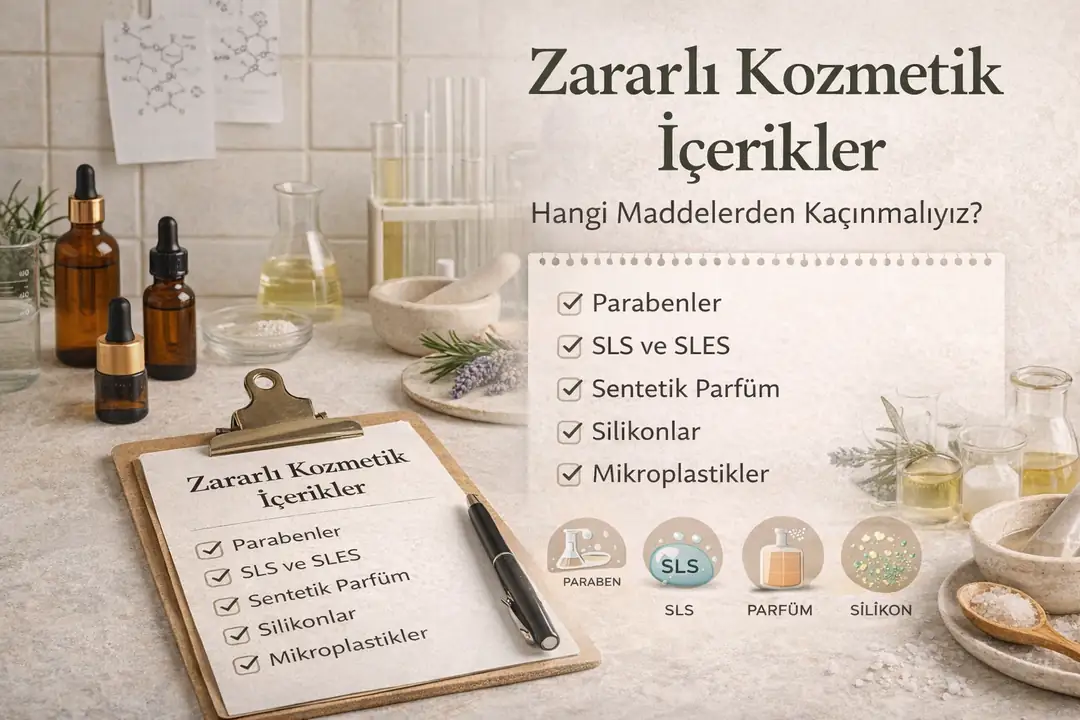
Harmful Ingredients in Cosmetics: Which Ingredients Should We Avoid?
When choosing skincare products, the ingredient list (INCI) is just as important as the promises written on the packaging. Today, thousands of different raw materials are used in the cosmetic industry, and some of them may have negative effects on skin health, hormonal balance, or the environment.
For this reason, being a conscious consumer and learning how to read product labels is extremely important. Knowing which ingredients to avoid can help you make healthier choices. This becomes even more critical for sensitive skin, acne-prone skin, or products used by children.
Below are some of the most commonly discussed ingredients in cosmetics that many experts suggest avoiding when possible.
1. Parabens
Parabens are synthetic preservatives commonly used in cosmetic products. They are added to formulations to extend shelf life and prevent the growth of microorganisms.
The most common types include:
- Methylparaben
- Propylparaben
- Butylparaben
- Ethylparaben
Some scientific studies suggest that parabens may mimic estrogen activity, raising concerns about potential effects on the hormonal system with long-term exposure. For this reason, many natural cosmetic brands prefer to formulate products without parabens.
2. SLS and SLES (Sulfates)
Sodium Lauryl Sulfate (SLS) and Sodium Laureth Sulfate (SLES) are strong cleansing agents commonly used in:
- shampoos
- facial cleansers
- shower gels
These ingredients create a rich lather, but in some individuals they may cause:
- dryness
- irritation
- damage to the skin barrier
For people with sensitive or eczema-prone skin, sulfate-free cleansers are often recommended.
3. Synthetic Fragrance (Fragrance / Parfum)
The terms “Fragrance” or “Parfum” on an ingredient list do not represent a single substance. Instead, they may refer to a mixture of hundreds of different chemical components.
Synthetic fragrance ingredients may cause:
- allergic reactions
- skin sensitivity
- headaches
in some individuals. For sensitive skin types, products that are fragrance-free or formulated with natural essential oils may be a better choice.
4. Mineral Oil and Petroleum Derivatives
Petroleum-derived ingredients are widely used in the cosmetic industry. These include:
- Mineral Oil
- Paraffinum Liquidum
- Petrolatum
These substances form an occlusive layer on the skin surface. In some skin types, this may contribute to clogged pores and acne formation. Additionally, petroleum derivatives are often debated from a sustainability perspective.
5. Silicones
Silicones are commonly used in cosmetics to create a smooth and silky texture. Some of the most common silicone ingredients include:
- Dimethicone
- Cyclopentasiloxane
- Cyclohexasiloxane
Silicones can give products a soft and velvety feel, but in some formulations long-term use may lead to build-up on the skin surface. Some silicone compounds are also known to be slow to biodegrade in the environment.
6. Formaldehyde-Releasing Preservatives
Certain cosmetic preservatives can release formaldehyde over time. Formaldehyde is a strong irritant and may trigger allergic reactions in some individuals.
Examples of preservatives that may release formaldehyde include:
- DMDM Hydantoin
- Imidazolidinyl Urea
- Quaternium-15
- Diazolidinyl Urea
For this reason, many modern cosmetic formulations are shifting toward safer alternative preservative systems.
7. Microplastics
Microplastics are tiny plastic particles that may be found in:
- exfoliating products
- some makeup formulations
- certain film-forming polymers
These particles:
- do not easily degrade in nature
- may contaminate water systems
- can accumulate in ecosystems
For this reason, sustainable cosmetic brands increasingly focus on developing microplastic-free formulations.
Why Is Conscious Cosmetic Selection Important?
Our skin is not only an aesthetic organ but also the largest protective barrier of the body. Because skincare products are used daily for many years, the safety and quality of ingredients become very important.
To make more informed choices:
- carefully examine product ingredient lists
- avoid unnecessary chemical load
- prefer ingredients supported by natural sources and scientific research
- choose products suitable for your skin type
Conclusion
Not every ingredient used in cosmetics is harmful. However, some substances remain controversial due to their potential effects on skin health and the environment. Therefore, developing the habit of reading ingredient lists and choosing reliable formulations is essential for conscious consumers.
Products formulated with the right ingredients do not only enhance appearance, but also help maintain the skin’s natural balance and long-term health.
KAYNAKÇA
Barel, A. O., Paye, M., & Maibach, H. I. (2014). Handbook of cosmetic science and technology (4th ed.). CRC Press.
Cosmetics Europe. (2023). Cosmetic ingredients and safety. https://cosmeticseurope.eu
European Commission. (2023). Cosmetic ingredients database (CosIng). https://ec.europa.eu/growth/tools-databases/cosing
Darbre, P. D., & Harvey, P. W. (2008). Paraben esters, review of recent studies of endocrine toxicity, absorption, esterase and human exposure, and discussion of potential human health risks. Journal of Applied Toxicology, 28(5), 561–578. https://doi.org/10.1002/jat.1358
Draelos, Z. D. (2015). Cosmetic dermatology: Products and procedures (3rd ed.). Wiley-Blackwell.
Lodén, M., & Maibach, H. I. (2012). Treatment of dry skin syndrome: The art and science of moisturizing. Springer.
Ribeiro, A., Estanqueiro, M., Oliveira, M., & Sousa Lobo, J. (2015). Main benefits and applicability of plant extracts in skin care products. Cosmetics, 2(2), 48–65. https://doi.org/10.3390/cosmetics2020048
United States Food and Drug Administration. (2023). Cosmetics and ingredients. https://www.fda.gov/cosmetics
UN Environment Programme. (2018). Single-use plastics: A roadmap for sustainability. https://www.unep.org
Gewert, B., Plassmann, M., & MacLeod, M. (2015). Pathways for degradation of plastic polymers floating in the marine environment. Environmental Science: Processes & Impacts, 17(9), 1513–1521. https://doi.org/10.1039/C5EM00207A